With the rapid evolution of unmanned aerial vehicle (UAV) technology, achieving extreme lightweighting without sacrificing structural strength and durability has become a key challenge for improving overall performance. Carbon fiber sheets, with their superior specific strength and stability, are gradually becoming an important material choice in this field, enabling engineers and UAV enthusiasts to continuously push performance boundaries. This article will explore how to utilize carbon fiber sheets for lightweight UAV design, leveraging their unique properties to improve flight efficiency, extend battery life, and enhance overall maneuverability. By applying carbon fiber sheets to the frame and key structural components, designers can significantly reduce the overall weight of the aircraft while maintaining structural integrity, typically achieving weight reductions of over 25% compared to traditional materials.
What is carbon fiber sheet?
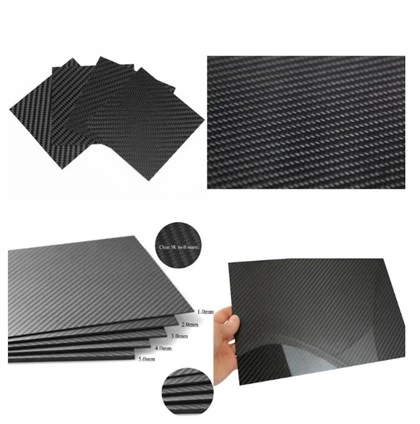
Carbon fiber board is a flat structure composed of carbon fiber reinforcement materials and polymer matrix (usually epoxy resin), which is cured at high temperature and pressure to form a lightweight panel with both high rigidity and low density. Developed for high-performance applications, these panels tend to have a typical tensile strength of over 3500 MPa, significantly higher than steel or aluminum alloys, and a density of only about 1.6 g/cm³, which is about one-fifth of steel. Tensile strength is a key measure of the maximum tensile stress a material can withstand before breaking, and is particularly important in aerospace, where structural components are subjected to complex and frequently changing dynamic loads over time.
Why are carbon fiber sheets suitable for lightweight drone designs?
The outstanding advantages of carbon fiber plates in lightweight drone design stem from their unique composite material structure. Carbon fiber is typically produced by carbonizing polyacrylonitrile (PAN) precursors at temperatures above 1000 °C, giving the material extremely high rigidity, with a Young's modulus reaching 240 GPa. Young's modulus reflects a material's ability to deform under stress; the higher the value, the less prone the structure is to bending, which is crucial for maintaining attitude stability during high-speed flight and intense maneuvers. High-rigidity structures effectively suppress frame deformation, reduce energy loss caused by vibration, and significantly improve handling responsiveness.
In practical applications, carbon fiber sheets are widely used in the main frame, arms, and fuselage structures of drones, achieving weight reductions of up to approximately 40% in some designs. Besides its lightweight advantage, carbon fiber sheets also possess excellent corrosion resistance, unlike metallic materials which experience performance degradation in humid or corrosive environments. Furthermore, its superior fatigue resistance allows it to withstand millions of cyclic loads without structural failure, a crucial factor for drones performing long-duration missions such as inspection or search and rescue. In terms of thermal stability, carbon fiber composites maintain structural integrity within a temperature range of −50 °C to 200 °C, making them suitable for various complex climatic conditions.
It is important to emphasize that these performance advantages are highly dependent on precise manufacturing processes. Carbon fiber sheets typically employ directional layup designs, such as 0°/90° cross layups or quasi-isotropic layups, to specifically optimize mechanical properties in different directions. Among these, quasi-isotropic layups, by uniformly distributing fibers in multiple directions, allow the composite material to approximate the isotropic characteristics of metallic materials in terms of overall performance, thereby achieving a more balanced performance between strength, stiffness, and reliability.
What are the best ways to apply carbon fiber plates to drone structures to achieve lightweight design?
Applying carbon fiber sheets to drone structures for lightweight design requires a combination of creative design, manufacturing precision, and materials science. The process begins with selecting suitable carbon fiber sheets, choosing the appropriate type based on specific application requirements. Common types include unidirectional lay-up or fabric lay-up structures, with thicknesses typically ranging from 0.5 mm to 3 mm, matched to structural loads and usage scenarios. For consumer or amateur drones, thinner sheets are sufficient to meet strength and stiffness requirements; however, for industrial applications or high-load missions, thicker carbon fiber sheets are needed to ensure structural safety margins.
In terms of structural forming, the mainstream approach is to use prepreg carbon fiber sheets for CNC machining. Using a computer numerical control (CNC) milling machine, the cured sheets can be precisely cut into common UAV frames such as X-shapes and H-shapes, or other customized structural forms, to meet different aerodynamic layouts and mechanical requirements. Prepreg sheets refer to carbon fiber fabrics that have been uniformly impregnated with a resin system before leaving the factory and cured in an autoclave environment, resulting in a composite material with a high fiber volume fraction and extremely low porosity. This process not only improves the consistency and reliability of the material but also provides a stable manufacturing foundation for the lightweight and high-strength design of UAV structures.
What challenges are encountered when using carbon fiber sheets for lightweight design in drone manufacturing?
While carbon fiber sheets demonstrate significant advantages in lightweight drone design, several key challenges remain to be addressed to ensure long-term reliable application. The primary issue is cost. High-quality carbon fiber sheets typically cost between $50 and $100 per square meter, approximately 5 to 8 times the price of comparable aluminum alloy sheets, which limits their scalability for mass-produced drones. The high cost stems primarily from the energy-intensive manufacturing process of carbon fiber itself, including pyrolysis at approximately 1200–1400 °C to convert precursor materials into high-purity carbon fibers. This pyrolysis process must be conducted in an inert atmosphere to ensure the integrity of the carbon structure and performance stability, further increasing production costs.
Besides material costs, the complexity of the manufacturing process also poses a significant challenge. Achieving uniform resin distribution within carbon fiber sheets typically requires vacuum-assisted impregnation or resin transfer molding (RTM) technology. These processes demand high precision equipment and process control to prevent delamination defects caused by uneven resin distribution. Delamination refers to the phenomenon of interlayer separation in composite materials under stress. Once it occurs, it significantly weakens structural strength and affects the safety and reliability of drones under complex operating conditions.
Conclusion
In summary, carbon fiber sheets, with their superior specific strength, high rigidity, excellent fatigue resistance, and good environmental adaptability, have become a highly valuable structural material in the lightweight design of UAVs. Through rational material selection, scientific layup design, and high-precision manufacturing processes, carbon fiber sheets can significantly reduce overall aircraft weight while improving flight efficiency, endurance, and handling performance. However, their high material and manufacturing costs, as well as the stringent requirements for process control, also pose greater challenges to application scale and production consistency. In the future, with the gradual decrease in the cost of carbon fiber raw materials, the continuous maturation of manufacturing technology, and the improvement of automation levels, the application of carbon fiber sheets in the UAV field is expected to become more widespread, playing an even more crucial role in high-performance, long-endurance, and specialized UAV platforms.
Contact us
Custom carbon fiber panels have become a preferred choice for aerospace engineers due to their lightweight strength, high performance, and durability. These panels drive innovation, enhance efficiency, and deliver practical benefits that meet stringent industry standards. By choosing a custom solution, engineers can unlock new possibilities in design, performance, and sustainability, ensuring that their projects stand out from the competition. Ready to elevate your aerospace applications? You can choose Dongguan Juli Composite Technology Co., Ltd. has 6 autoclaves to make carbon fiber plates, with an average daily output value of 800+ pieces, faster delivery, contact WhatsApp+86 18822947075 or email sales18@julitech.cn for more details .