In today's high-tech materials field, carbon fiber composites are widely used in aerospace, automotive, sporting goods, and many other industries due to their superior performance. Carbon fiber sheets, as a crucial component, have their manufacturing process directly determining the quality of the final product. The autoclave process, as a core method for producing high-end carbon fiber sheets, has always attracted significant attention. So, what is the quality of carbon fiber sheets produced using the autoclave process? This article will delve into this question, providing a comprehensive analysis from process principles and performance advantages to application scenarios.
What is the autoclave process?
Autoclave processing is a manufacturing technology that utilizes a high-temperature, high-pressure environment to process composite materials. This process typically takes place in a sealed autoclave, where precise temperature and pressure control allows the resin matrix to fully impregnate the fibers and cure. The specific process includes multiple steps such as material layup, bag sealing, and in-cabin curing. Because the entire process is carried out under controlled high pressure and high temperature, autoclave processing can significantly increase the fiber content and reduce porosity of composite materials, thereby achieving superior mechanical properties and consistency.
Quality advantages of autoclave process for carbon fiber sheets
High strength and stiffness
Through autoclave processing, carbon fiber sheets can achieve higher fiber volume fractions (typically exceeding 60%), while also exhibiting more uniform resin distribution. This structure endows the sheets with extremely high specific strength and specific stiffness, with tensile strength, compressive strength, and flexural strength surpassing many traditional metal materials. For example, some autoclave-formed carbon fiber sheets can be more than five times stronger than traditional steel, while weighing only a fraction of it.
Low porosity and excellent consistency
The high-pressure environment provided by the autoclave effectively reduces porosity and defects in the material. Porosity can typically be controlled below 2%, which significantly improves the material's fatigue life and durability. Furthermore, because the parameters throughout the curing process are precisely controllable, the produced carbon fiber sheets exhibit high batch-to-batch consistency, making them ideal for large-scale and high-standard applications.
Excellent surface quality and lightweight properties
Autoclave processing produces smooth, defect-free carbon fiber sheets without extensive subsequent processing. Furthermore, the low density and high mechanical properties of carbon fiber itself result in significant weight reduction. This is particularly important in the aerospace and automotive industries, as weight reduction directly improves fuel efficiency and performance.
Good environmental resistance
Carbon fiber sheets cured in an autoclave typically exhibit better chemical resistance, heat resistance, and moisture resistance. Their resin system cures more thoroughly under high temperature and pressure, enabling them to withstand various harsh environmental conditions and extending product lifespan.
Autoclave carbon fiber plates compared with other processes
Autoclave vs. Molding Process
1. Pressure and exhaust capacity
The molding pressure is low, and the air is not easy to expel out.
The autoclave combines a vacuum bag with high pressure for adequate venting.
Inadequate exhaust can lead to many internal defects and affected mechanical properties.
2. The degree of material density
The molded material has a medium density.
Autoclave materials are highly dense and compact.
The higher the density, the better the strength and fatigue life.
3. Appearance quality
The molded surface is limited by mold, which is prone to ripples and resin buildup.
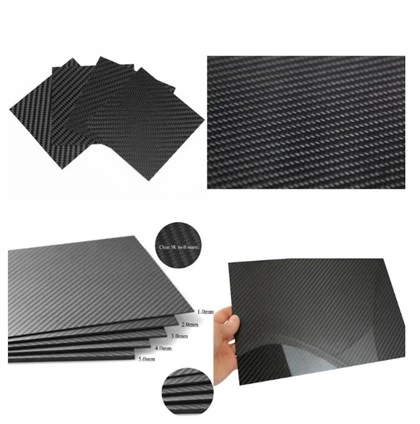
The surface texture of the autoclave is flat, and the patterns such as 3K and UD are clear.
For products with extremely high requirements for appearance, autoclaves are more advantageous.
4. Consistency
The batch stability of molded products is good.
Autoclaves can be finely controlled due to the curing curve, and their stability is higher.
In summary, molding is suitable for mid-range industrial products, while autoclave is suitable for high-end industries that pursue ultimate performance.
Application scenarios of autoclave process
Thanks to its excellent quality performance, autoclave process carbon fiber sheets are widely used in a number of high-tech fields.
In the aerospace industry, it is used to manufacture aircraft wings, fuselage components, to meet stringent weight and safety requirements.
In automotive manufacturing, the material is widely used in high-performance cars and racing cars to reduce weight and improve structural strength. Additionally, autoclave carbon fiber plates are widely relied upon for sports equipment (e.g., bicycle racks, golf clubs), industrial machinery, and new energy equipment (e.g., wind blades).
Why are autoclaved carbon fiber sheets more expensive?
In the carbon fiber composite materials industry, autoclave technology is often categorized as a "high-cost, high-quality" manufacturing process. Many customers or purchasing personnel ask: Why is the price of autoclave technology two to three times, or even more, than that of ordinary processes for the same carbon fiber sheet? The answer is not just that the equipment is more expensive or the process is more complicated, but that this process system has high barriers to entry in terms of materials, equipment, process control, and personnel qualifications, making its cost structure and performance attributes far superior to other processes.
High-quality prepregs are expensive, costing several times more than ordinary carbon cloth.
The autoclave production uses carbon fiber prepreg instead of dry cloth with resin. The prepreg is made by uniformly impregnating the carbon cloth with the resin system in advance, and the resin content is usually controlled between 35% and 38%, with an error of only ±1%.
Autoclave equipment requires a huge investment, has high maintenance costs, and consumes considerable energy.
Autoclaves are large, high-pressure, and high-temperature equipment, and their price is almost a "heavy asset" indicator in the composite materials industry.
Small autoclave (1 meter in diameter, 2 meters in length): several hundred thousand yuan.
Medium to large autoclaves (2 meters in diameter, 4 to 6 meters in length): 1 million to 3 million yuan.
Aerospace-grade autoclaves (multi-zone temperature and pressure control, higher tolerance): 5 million to 10 million units.
The equipment consumption and operating costs of autoclaving for one-time products are much higher than those of ordinary molding or vacuum infusion processes.
High skill levels are required for operators; they must possess specialized expertise.
Autoclave process personnel must have a background in composite materials or have received extensive training, including:
Ply direction control
Vacuum system packaging
Understanding Curing Parameters
Adhesion Defect Judgment
Defect Repair Techniques
Process Records and Batch Tracking
Talent costs are also a significant source of overall costs.
Conclusion
Overall, carbon fiber sheets produced using the autoclave process exhibit excellent quality, possessing core advantages such as high strength, low porosity, lightweight, and high consistency. While the cost is higher, its performance returns make it an ideal choice for aerospace, automotive, and high-end industrial applications. With continuous technological innovation, this process will continue to lead the development of carbon fiber composites, providing higher-quality solutions for various industries.
Contact us
We are a carbon fiber product manufacturer from China with 2 large autoclave machines and 5 CNCC (China National Carbon Fiber) machines, as well as pultrusion and coil production lines. If you need to select suitable carbon fiber sheets, please contact us. We have 20 years of industry experience and our quality meets ISO-9001 standards. You don't need to worry about quality. You are also welcome to visit our factory. Please contact us via: Email: sales18@julitech.cn or WhatsApp: +86 18822947075.