With the continuous advancement of unmanned aerial vehicle (UAV) technology, its applications have far exceeded the entertainment field, widely penetrating industries with high precision requirements such as film shooting, industrial inspection, and search and rescue. The core driving force behind this transformation lies in the continuous optimization of flight stability. Against this backdrop, exploring how to improve flight stability through carbon fiber UAV components has become crucial for achieving technological breakthroughs.
Why does the choice of materials determine the balance in the air?
The dynamic performance of a drone during flight essentially depends on the coupling relationship between thrust, weight, and structural stiffness. Traditional plastic or injection-molded components are prone to structural deformations such as slight bending of the arms when subjected to propeller downwash and dynamic loads. These minute deformations transmit additional noise to the flight control system (FC), thereby increasing the adjustment burden on the PID (proportional-integral-derivative) control loop and affecting hovering stability.
The aforementioned problems can be significantly improved by using carbon fiber drone components. Carbon fiber composites possess high Young's modulus and excellent rigidity, enabling the frame to maintain geometric stability under high-torque maneuvers and complex operating conditions. This structural stability helps reduce sensor noise, resulting in cleaner and more reliable gyroscope and accelerometer outputs, thereby improving the flight control system's response accuracy and overall handling stability, making it particularly suitable for demanding scenarios such as long-distance operations and high-speed image acquisition.
Table 1: Material Comparison for Drone Components
| Material Property | Polycarbonate/ABS Plastic | Aluminum Alloy (6061) | Carbon Fiber Composite |
| Density | 1.05 – 1.20 | 2.70 | 1.55 – 1.75 |
| Tensile Strength | Low to Moderate | High | Very High |
| Vibration Damping | Poor (Elastic) | Moderate | Excellent (Rigid) |
| Flexural Modulus | ~2.3 GPa | ~70 GPa | ~135+ GPa |
| Primary Use Case | Entry-level/Toy | Structural Brackets | Hight-Performance/Pro |
What role do carbon fiber propellers play in reducing vibration?
When exploring the use of carbon fiber drone components to improve flight stability, propellers are one of the most crucial entry points. Traditional plastic propellers are prone to "blade flutter" under high-speed conditions: as the speed increases, the blade tip may hysteresis or elastic deformation, which in turn leads to uneven lift distribution and high-frequency vibration.In contrast, carbon fiber propellers are typically manufactured using a high-pressure molding process, resulting in higher rigidity and lower mass. The reduced mass of rotating components means less moment of inertia, allowing the motor to respond more quickly and precisely to changes in speed, thereby improving overall control performance.
In terms of image quality, high-frequency micro-vibrations often cause the "jelly effect" (rolling shutter distortion) in aerial footage. The high rigidity of carbon fiber materials can suppress such vibrations at the source, significantly improving image stability. At the same time, because the blades are not easily deformed under load, their aerodynamic shape can remain stable, thereby maintaining a more consistent lift-to-drag ratio (L/D) throughout the entire throttle range and improving propulsion efficiency.
Furthermore, professional-grade carbon fiber propellers typically undergo high-precision dynamic balancing (down to the milligram level) before leaving the factory, further reducing vibration sources and optimizing flight trajectory. When used with a lightweight carbon fiber frame, it can also effectively prevent structural resonance between the motor support and the propeller's operating frequency, resulting in a more stable and efficient power system.
How can carbon fiber reinforced materials be used to optimize frame rigidity?
The frame is the fundamental load-bearing structure of a drone, essentially the "skeleton" of the entire aircraft. If the structural rigidity is insufficient, even a flight control system (FC) with high-precision algorithms will struggle to achieve accurate attitude control. Therefore, when using carbon fiber components to improve flight stability, the frame's ply structure and plate thickness are crucial parameters that must be carefully considered.
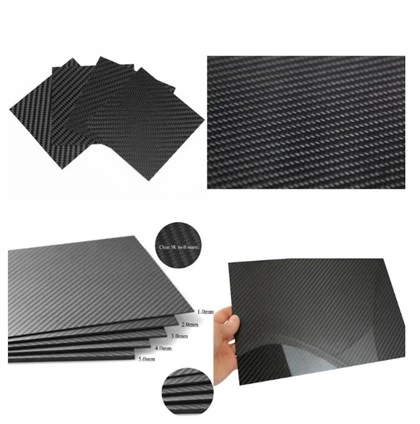
Most current high-end airframes utilize 3K twill carbon fiber, where "3K" refers to the approximately 3,000 monofilaments per bundle. This weave structure provides a more balanced distribution of mechanical properties in the plane (X/Y directions), resulting in more stable response characteristics under multi-directional forces. During high-speed maneuvers or sharp turns, centrifugal loads can exert significant bending and torsional loads on the arms. Carbon fiber arms, with their excellent torsional stiffness, effectively suppress structural deformation, ensuring that the motor thrust vector remains consistent with the airframe design, thereby improving overall flight stability and control precision.
Can carbon fiber landing gear and gimbals enhance external stability?
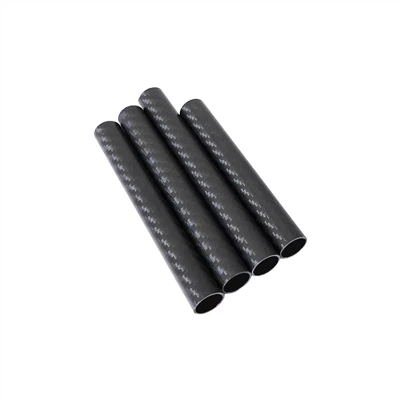
Flight stability is not limited to attitude maintenance; it also depends on the coupling relationship between the UAV, its payload, and the external environment. In this respect, carbon fiber components also play a crucial role in key components such as landing gear and camera mounts.In terms of vibration control, the carbon fiber gimbal plate can be regarded as a "passive filtering unit" at the structural level. Even if the motor generates slight vibrations, the carbon fiber composite material can effectively attenuate the vibrations before they are transmitted to the camera sensor, thereby improving imaging stability and clarity.From an aerodynamic perspective, landing gear made of carbon fiber tubing typically has higher strength and smaller cross-sectional dimensions. While meeting structural requirements, it reduces the frontal area, effectively weakens the "sail effect" under crosswinds, and improves course retention.
Furthermore, the more rigid carbon fiber propellers work synergistically with structural components to help maintain stable aerodynamic characteristics, making the aircraft less prone to entering aerodynamically unstable regions such as "vortex ring states" in complex airflow environments. These types of problems are often more likely to occur in aircraft with greater mass and insufficient structural rigidity.
Conclusion
In summary, improved flight stability does not rely on optimizing a single component, but rather stems from the systematic synergy between material properties, structural design, and the propulsion system. Carbon fiber, with its high specific strength, high stiffness, and excellent structural consistency, provides a more stable mechanical foundation in UAV frames, propellers, landing gear, and load support structures. This results not only in improved vibration suppression and structural resistance to deformation, but also directly enhances the data quality of flight control sensors and the accuracy of control response.

One-stop Cosmetic Tube Factory in China
We are a manufacturer from China with 20 years of experience in the composite materials industry. We specialize in carbon fiber tubes, sheets, and custom-shaped parts, and have dozens of production lines. We offer fast delivery. If you are looking for composite materials, please contact us.