In the world of advanced materials, carbon fiber stands out for its exceptional strength-to-weight ratio, stiffness, and adaptability. It has transformed industries from high-speed motorsports to modern aerospace engineering. However, not every type of carbon fiber is created equal. The term "carbon fiber" refers to a broad range of materials, each designed with specific properties for a particular application. Understanding the different grades of carbon fiber is crucial for engineers, designers, and innovators to fully exploit their capabilities. These grades are largely determined by their mechanical properties, particularly tensile modulus and tensile strength, which directly impact their performance and suitability for different applications.
What determines the grade of carbon fiber?
Carbon fiber grades are primarily classified based on their tensile modulus, which reflects stiffness and resistance to stretching or bending. Another important factor is tensile strength, the maximum load a fiber can withstand before breaking. Generally speaking, fibers with a higher tensile modulus tend to have lower tensile strength, making them more brittle. This trade-off is an important consideration in material selection. Manufacturing methods, particularly the final heat treatment temperature, play a crucial role in shaping these properties.
The choice of precursor material used in production has a significant impact on the properties and grade of carbon fiber.
PAN-based carbon fibers
These fibers are made from polyacrylonitrile (PAN) and account for over 90% of global carbon fiber production. They are known for their excellent tensile strength and possess a wide modulus range. Their production process involves spinning PAN into fibers, which are then stabilized, carbonized, and, in some cases, subjected to additional processing to further enhance their properties.
Pitch-based carbon fibers
These fibers are derived from petroleum or coal tar pitch and can achieve extremely high modulus values, often higher than those of PAN-based fibers. Their manufacturing process relies on different technologies specific to the pitch precursor, and due to their ultra-high stiffness and excellent thermal conductivity, these fibers are typically reserved for applications requiring exceptional stiffness and heat resistance.
Understanding "K" Levels
You'll often see carbon fiber described with a "K" number, such as 3K or 12K. The "K" refers to the thousands of individual carbon fiber filaments bundled together in a single strand, or "tow." For example, a 3K tow consists of 3,000 filaments. A common misconception is that the "K" value reflects the quality or grade of the carbon fiber. In reality, it simply indicates the tow size. While the 3K weave is widely known for its traditional carbon fiber appearance, larger tows like 12K allow for more efficient production of thicker laminates. Ultimately, the choice of tow size depends on manufacturing requirements and the desired visual finish of the final product.
Carbon fiber grade range
Carbon fiber grades (from standard modulus to ultra-high modulus) are typically classified by their tensile modulus, expressed in megasquare inches (MSI) or kilopascals (GPa).
Standard Modulus (SM) Carbon Fiber
This is the most commonly used and cost-effective grade of carbon fiber. It offers an excellent balance between strength and stiffness, making it suitable for a wide range of applications. Standard modulus carbon fiber typically has a tensile modulus of approximately 33 MSI (227 GPa), which represents a significant performance advantage over traditional materials such as steel and aluminum.
Applications of standard modulus carbon fiber
Bicycle frames, tennis rackets, hockey sticks and other sports equipment
Auto parts, including body panels and interior trim
General industrial use Consumer electronics
Intermediate modulus (IM) carbon fiber
As the name implies, intermediate modulus carbon fibers offer greater stiffness than standard grades. IM fibers strike a balance between high stiffness and strong tensile strength. With a tensile modulus of approximately 42 MSI (289 GPa), they are often chosen for applications that require higher performance while avoiding the greater expense associated with high modulus fibers.
Applications of intermediate modulus carbon fiber
Aerospace structures
High-performance automotive parts
Top-end sports equipment
Industrial robots
High modulus (HM) carbon fiber
High-modulus carbon fibers possess exceptional stiffness, achieved through additional high-temperature processing that creates a finer crystalline structure. This results in a tensile modulus of 55 MSI (393 GPa) or higher. However, this increase in stiffness often comes with a trade-off: reduced tensile strength and increased brittleness. Due to the more complex and energy-intensive manufacturing process, high-modulus carbon fibers also come at a significantly higher price.
Application of high modulus carbon fiber
Aerospace and satellite components where extreme stiffness is critical
Formula 1 and other elite motorsports
High-end industrial machinery
Ultra-high modulus (UHM) carbon fiber
At the high end of carbon fiber technology lies ultra-high modulus (UHM) carbon fibers. These fibers, typically produced from pitch-based precursors, exhibit maximum stiffness, with tensile moduli exceeding 110 MSI (758 GPa). Due to their high cost, UHM fibers are used only in the most demanding applications, where maximum stiffness and minimal deflection under load are crucial.
Application of ultra-high modulus carbon fiber
Spacecraft and satellite structures
Advanced military applications
Specialized scientific instruments
How does the weave pattern affect carbon fiber performance?
In addition to the inherent properties of the carbon fiber filaments, the way they are woven into the fabric also affects the properties of the finished composite. Although many weave patterns exist, the most commonly used are plain, twill, and satin weaves.
Plain weave
This is the simplest and most common weave, with a classic checkerboard look. It offers good stability and is easy to work with.
Twill Weave
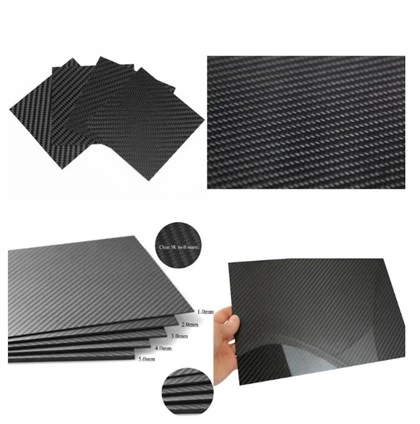
In a twill weave, the tows pass over two or more tows and then under one or more tows, creating a diagonal pattern. This makes the fabric more flexible and better suited to conforming to complex shapes.
Satin Weave
A satin weave has less crossover between strands, resulting in a smooth, flat surface. This weave is highly drapey and well-suited for parts with complex contours.
Unidirectional
In this form, all fibers are aligned in one direction. [15] This provides the greatest strength and stiffness in that direction, but is weaker in other directions. Composite parts are often constructed from multiple layers of unidirectional carbon fibers oriented in different directions to achieve a balanced strength profile.
The following table summarizes the characteristics of common carbon fiber weave patterns
| Weave Pattern | Appearance | Characteristics | Common Applications |
| Plain Weave | Checkerboard | Stable, balanced strength, less pliable | Flat sheets, simple tubes |
| Twill Weave | Diagonal pattern | More pliable than plain weave, good for complex curves | Automotive components, sporting goods |
| Satin Weave | Smooth, glossy finish | Highly drapable, ideal for intricate shapes | Aerospace components, high-end aesthetics |
| Unidirectional | Aligned in one direction | Maximum strength and stiffness in one direction | Structural reinforcements, high-performance parts |
How do different grades of carbon fiber affect cost?
A key factor influencing the application of different carbon fiber grades is cost. The price of carbon fiber is closely related to the complexity and energy consumption of the manufacturing process. Standard modulus carbon fiber is the most economical option, typically priced between $10 and $20 per pound. However, as performance requirements increase, so does the price. Producing high-modulus and ultra-high-modulus fibers involves more intensive heat treatment and, in some cases, requires specialized precursor materials. This can drive costs to over $150 per pound. The choice of precursor also influences pricing. While PAN-based fibers are widely used, their manufacturing process is more complex than some pitch-based alternatives, resulting in higher costs. Therefore, selecting the right carbon fiber grade often requires balancing performance requirements with budgetary constraints.
Conclusion
Carbon fiber isn't a single, homogeneous material, but rather a range of grades, each defined by its own balance of stiffness, strength, and cost. This diversity enables engineers and designers to select the right solution for a specific application. Standard modulus fibers are widely used in everyday sporting goods due to their comprehensive properties, while ultra-high modulus grades are reserved for the extreme performance requirements of aerospace. The ability to match the right grade with the right application is crucial to driving innovation. As manufacturing technology continues to advance and costs decrease, the range of industries adopting carbon fiber will only expand, further solidifying its position as a cornerstone of modern engineering.
Contact us
Want to learn more about carbon fiber? Contact Dongguan Juli Composite Materials Technology Co., Ltd. with 25 years of industry experience. To learn more about our carbon fiber products, please email sales18@julitech.cn or contact us via WhatsApp at +86 18822947075.