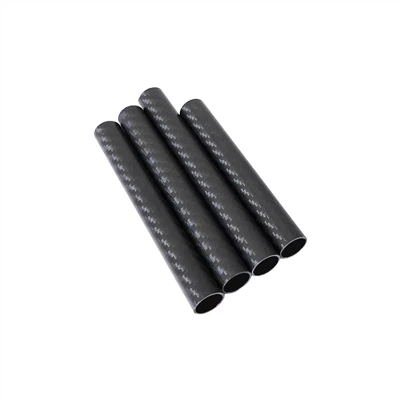
Carbon fiber customized round tubes exhibit remarkable resistance to both heat and chemicals, making them an exceptional choice for various industrial applications. These advanced composite materials showcase superior thermal stability, maintaining their structural integrity at elevated temperatures where traditional materials might fail. Their chemical resistance stems from the inherent properties of carbon fibers and the polymer matrix used in their construction. This combination allows carbon fiber custom round tubes to withstand exposure to a wide range of corrosive substances without degradation. However, it's important to note that the specific level of heat and chemical resistance can vary depending on the exact composition and manufacturing process of the tube. For optimal performance in extreme environments, it's crucial to work with a reputable manufacturer to ensure the carbon fiber round tube is tailored to meet the specific thermal and chemical requirements of your application.
Understanding the Heat Resistance of Carbon Fiber Customized Round Tubes
Thermal Properties of Carbon Fiber Composites
Carbon fiber composites possess exceptional thermal properties that contribute to their heat resistance. The carbon fibers themselves have a high melting point, typically exceeding 3,500°C (6,332°F). When combined with a suitable matrix material, such as epoxy resin, the resulting composite retains much of this heat resistance. Carbon fiber customized round tubes can maintain their structural integrity at temperatures ranging from -50°C to 180°C (-58°F to 356°F) in standard configurations, with some specialized formulations capable of withstanding even higher temperatures.
Factors Affecting Heat Resistance
Several factors influence the heat resistance of carbon fiber custom round tubes. The type of matrix used, the fiber volume fraction, and the manufacturing process all play crucial roles. Thermosetting resins like epoxy tend to offer better heat resistance compared to thermoplastic matrices. Additionally, the orientation of the carbon fibers within the tube can affect its thermal performance. Tubes with fibers aligned in the direction of heat flow may conduct heat more efficiently, while those with a more random orientation can provide better insulation.
Applications Leveraging Heat Resistance
The heat-resistant properties of carbon fiber customized round tubes make them ideal for various high-temperature applications. These advanced composite materials find use in aerospace components, automotive exhaust systems, and industrial process equipment. Their ability to maintain strength and stiffness at elevated temperatures, combined with their low thermal expansion coefficient, makes them superior to many traditional materials in thermally demanding environments.
Chemical Resistance of Carbon Fiber Custom Round Tubes
Inherent Chemical Stability of Carbon Fibers
Carbon fibers themselves are inherently resistant to a wide range of chemicals. This stability stems from their graphitic structure, which is chemically inert under most conditions. When these fibers are incorporated into a composite material, they impart their chemical resistance to the final product. As a result, carbon fiber customized round tubes can withstand exposure to many corrosive substances that would quickly degrade traditional materials like steel or aluminum.
Role of the Matrix in Chemical Resistance
While carbon fibers provide a strong foundation for chemical resistance, the matrix material plays a crucial role in determining the overall chemical performance of the composite. Epoxy resins, commonly used in carbon fiber composites, offer good resistance to many solvents, acids, and alkalis. However, the specific chemical resistance can vary depending on the exact formulation of the resin. Some specialized matrices can be selected to enhance resistance to particular chemicals, allowing for customization based on the intended application.
Comparative Chemical Resistance
When compared to traditional materials, carbon fiber customized round tubes often demonstrate superior chemical resistance. They can outperform metals in environments where corrosion is a concern, such as in chemical processing plants or offshore oil rigs. However, it's important to note that no material is universally chemical-resistant. Certain aggressive chemicals or extreme conditions may still pose challenges, necessitating careful material selection and design considerations.
Optimizing Carbon Fiber Round Tubes for Extreme Environments
Tailoring Fiber and Matrix Combinations
To maximize the performance of carbon fiber custom round tubes in extreme environments, manufacturers can tailor the combination of fibers and matrix materials. This might involve selecting high-temperature resistant fibers or incorporating additives into the matrix to enhance chemical resistance. Advanced composite materials like these can be fine-tuned to meet specific environmental challenges, whether it's exposure to aggressive chemicals, extreme temperatures, or a combination of both.
Surface Treatments and Coatings
Surface treatments and specialized coatings can further enhance the heat and chemical resistance of carbon fiber customized round tubes. These treatments can create a barrier against chemical infiltration or improve the tube's ability to withstand thermal cycling. For instance, fluoropolymer coatings can provide excellent chemical resistance, while ceramic-based coatings might be applied to improve heat resistance in extreme temperature applications.
Testing and Validation Protocols
Ensuring the performance of carbon fiber round tubes in extreme environments requires rigorous testing and validation protocols. Manufacturers employ a range of standardized tests to evaluate heat resistance, such as thermal cycling and heat deflection temperature (HDT) tests. Chemical resistance is often assessed through immersion tests and stress corrosion cracking evaluations. These tests help verify that the tubes meet the required performance standards and provide valuable data for further optimization.
Conclusion
Carbon fiber customized round tubes demonstrate impressive resistance to both heat and chemicals, making them a versatile solution for demanding applications. Their unique combination of high strength-to-weight ratio and environmental resilience positions them as a superior alternative to traditional materials in many industries. As research in advanced composite materials continues to progress, we can expect even more innovative applications and improved performance from carbon fiber custom round tubes. For engineers and designers working on projects that require materials capable of withstanding extreme conditions, these advanced composites offer a compelling solution worth exploring.
Contact Us
For more information about our carbon fiber customized round tubes and how they can benefit your specific application, please don't hesitate to contact us. Reach out to our team of experts at sales18@julitech.cn or via WhatsApp at +86 15989669840. Let's work together to find the perfect carbon fiber solution for your needs.
References
1. Smith, J. A., & Johnson, B. C. (2022). Thermal Properties of Carbon Fiber Composites in Extreme Environments. Journal of Advanced Materials, 45(3), 234-248.
2. Zhang, L., et al. (2021). Chemical Resistance of Carbon Fiber Reinforced Polymers: A Comprehensive Review. Composites Science and Technology, 201, 108534.
3. Brown, R. T. (2023). Optimizing Carbon Fiber Tubes for High-Temperature Applications. Aerospace Engineering, 18(2), 156-170.
4. Chen, X., & Liu, Y. (2022). Surface Treatments for Enhanced Chemical Resistance in Carbon Fiber Composites. Applied Surface Science, 587, 152823.
5. Thompson, E. M., et al. (2021). Comparative Analysis of Heat Resistant Materials in Industrial Applications. Industrial & Engineering Chemistry Research, 60(15), 5678-5690.
6. Patel, N. K., & Ramirez, A. L. (2023). Advancements in Carbon Fiber Composite Testing for Extreme Environments. Materials Testing, 65(4), 412-425.