Why Are Carbon Fiber Tubes So Lightweight?
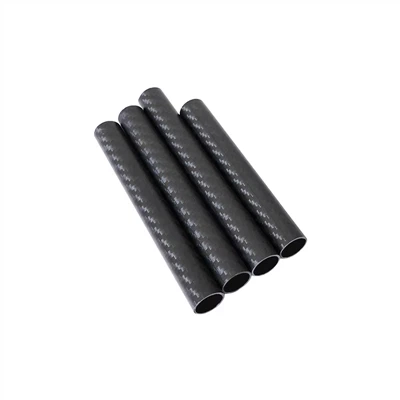
Carbon fiber tubes are widely used in aerospace structures, UAV frames, robotic arms, fishing rods, camera supports, medical equipment, automation machinery, sports equipment, and other applications where structural weight matters. Their popularity comes from a combination of low density, high stiffness, high tensile strength, corrosion resistance, and the ability to tailor fiber orientation to the direction of applied loads.
But why are carbon fiber tubes so lightweight?The answer is not simply that carbon fiber is "lighter than metal." The lightweight behavior of a carbon fiber tube results from the interaction between material density, tubular geometry, fiber orientation, fiber volume fraction, resin content, and manufacturing technology.
A representative high-strength carbon fiber such as Toray T700S has a reported fiber density of 1.80 g/cm³, tensile strength of 4,900 MPa, tensile modulus of 230 GPa, and filament diameter of approximately 7 μm. Toray also reports normalized T700S/epoxy composite properties at 60% fiber volume, including 2,860 MPa tensile strength and 134 GPa tensile modulus.
These numbers help explain why carbon fiber tubes can achieve high structural efficiency without requiring the mass associated with traditional metals.
However, there is an important distinction: carbon fiber is a reinforcement, while a carbon fiber tube is normally a composite structure. The finished tube contains carbon fibers, polymer resin, and sometimes additional surface or core materials. Consequently, its final density and mechanical performance depend on the complete manufacturing design.
The following sections examine the science behind lightweight carbon fiber tubes, explain the relevant engineering terminology, compare carbon fiber tubes with conventional metals, and discuss practical manufacturing problems and solutions.
What Is the Density of Carbon Fiber Tubes?
Density is the starting point for understanding lightweight materials. In engineering, density is defined as mass per unit volume: ρ = m / V where ρ is density, m is mass, and V is volume. A material with lower density contains less mass in the same volume. Carbon fiber is particularly attractive because commercial fibers typically have densities around 1.75–1.90 g/cm³, depending on grade and structure. Toray's T700S provides a useful industrial reference. Its published fiber density is 1.80 g/cm³, while its tensile strength is 4,900 MPa and tensile modulus is 230 GPa. Hexcel's published PAN carbon-fiber data also demonstrate that high-performance carbon fibers generally remain close to this density range. For example, its technical data list AS4 around 1.79 g/cm³, IM7 around 1.80 g/cm³, and HM63 around 1.76 g/cm³.
For comparison, common structural materials have considerably different densities.
| Material | Approximate Density | Relative Weight |
| Carbon fiber | 1.75–1.90 g/cm³ | Very low |
| CFRP tube | Typically dependent on fiber/resin ratio | Low |
| Aluminum alloy | ~2.7 g/cm³ | Moderate |
| Titanium alloy | ~4.5 g/cm³ | High |
| Steel | ~7.8 g/cm³ | Very high |
For a finished carbon fiber tube engineers should not simply copy the fiber density from a carbon fiber datasheet. The tube also contains resin.
The final tube density therefore depends on:
- Carbon fiber grade
- Resin density
- Fiber volume fraction
- Void content
- Fiber orientation
- Tube wall thickness
- Manufacturing process
- Surface coatings
- Inserts or additional materials
This distinction is especially important when comparing carbon fiber tube low density with aluminum or steel tubing. The correct comparison should be between finished components with equivalent structural requirements-not merely between raw fibers and metal.
Why Does the Tubular Shape Make Carbon Fiber Tubes Even More Weight-Efficient?
The second reason carbon fiber tubes are lightweight is their geometry. A tube does not need to contain solid material throughout its cross-section. Instead, much of its structural material is positioned around the outer perimeter, creating a high second moment of area, also called the area moment of inertia. This is a geometric property that describes how effectively a cross-section distributes material relative to a bending axis. For bending, moving material farther from the neutral axis can significantly increase bending stiffness without increasing mass proportionally.
This explains why tubes are used extensively in structures such as:
- UAV arms
- Bicycle frames
- Robotic links
- Camera booms
- Telescopic poles
- Fishing rods
- Aerospace structural members
- Drive shafts Industrial rollers
How Does Fiber Orientation Make Carbon Fiber Tubes Strong Without Making Them Heavy?
The third major reason is fiber orientation. Carbon fiber is highly anisotropic. This means its mechanical properties vary according to direction. Toray's T700S illustrates the difference between fiber-level and transverse composite behavior. The fiber has a tensile strength of 4,900 MPa and modulus of 230 GPa, while the normalized 60%-fiber-volume epoxy composite has a reported 0° tensile strength of 2,860 MPa and tensile modulus of 134 GPa. The reason for this directional performance is the orientation of the carbon fibers. A tube subjected primarily to axial tension benefits from fibers oriented close to 0°, parallel to the tube axis. A tube exposed to torsion requires significant ±45° reinforcement, because these fibers efficiently carry shear stresses. A pressure vessel may require hoop-oriented reinforcement, because circumferential stress becomes important.
A practical carbon fiber tube can therefore use multiple orientations:
- 0°: axial stiffness and tensile strength
- ±45°: torsional and shear performance
- 90°: transverse stability and hoop reinforcement
- Hybrid layups: balance multiple load cases
This is a major difference from conventional isotropic metals. A steel tube generally has relatively similar properties in different directions. A carbon fiber tube can be engineered so that reinforcement is concentrated where the loads actually occur.
How Does the Strength-to-Weight Ratio of Carbon Fiber Tubes Compare With Aluminum and Steel?
Strength-to-weight ratio is one of the most important concepts in lightweight structural engineering. The technical term is specific strength, which is commonly expressed as tensile strength divided by density. A similar parameter, specific stiffness, compares Young's modulus with density. Using Toray's T700S fiber as an example: Tensile strength = 4,900 MPa Density = 1.80 g/cm³ Tensile modulus = 230 GPa These properties create a very high fiber-level specific strength and specific stiffness. But engineers should be careful when making direct comparisons. A carbon fiber tube is a laminate composite, while an aluminum or steel tube is generally an isotropic metallic structure. The final performance depends on wall thickness, diameter, manufacturing process, joints, local buckling, impact resistance, and loading direction.
| Characteristic | Carbon Fiber Tube | Aluminum Tube | Steel Tube |
| Density | Low | Moderate | High |
| Specific strength | Very high | Moderate to high
|
Moderate |
| Specific stiffness | Very high | Moderate | Moderate |
| Directional properties | Strongly directional | Relatively isotropic | Relatively isotropic |
| Corrosion resistance | Generally excellent | Good but alloy dependent | Requires protection |
| Fiber orientation | Can be optimized | Not applicable | Not applicable |
| Manufacturing complexity | Higher | Moderate | Moderate |
| Joining | Requires specialized | Relatively mature | Relatively mature |
| Cost | Generally higher | Moderate | Lower |
DOE research identifies carbon fiber composites as one of the advanced lightweight materials capable of substantial mass reduction. Its transportation materials program estimates that carbon fiber composites could reduce the weight of some components by approximately 50–70%, while also noting cost, joining, modeling, and recycling as important barriers. DOE also states that a 10% reduction in vehicle weight can result in approximately 6–8% improvement in fuel economy, although actual system-level results depend on vehicle design and operating conditions.
This demonstrates why lightweight carbon fiber tubes are valuable beyond the tube itself. Reducing the mass of a moving robotic arm, UAV boom, drive shaft, or aerospace structure can reduce the loads imposed on other components.
For example, a lighter robotic link can reduce actuator requirements. A lighter UAV boom can reduce the structural mass that must be lifted continuously. A lighter rotating shaft can reduce rotational inertia. Therefore, the real benefit of carbon fiber tubes is often system-level mass reduction, rather than simply making one component lighter.
Why Can Carbon Fiber Tubes Be Lightweight Without Losing Rigidity?
Lightweighting often creates a concern: if a tube becomes thinner, will it become too flexible? The answer depends on whether the design is controlled by strength or stiffness. Strength concerns whether the component can withstand the applied load without failure. Stiffness concerns how much the component deforms under that load.
For many carbon fiber tubes, stiffness rather than ultimate tensile strength determines the required wall thickness.
This is particularly important for:
- Robotic arms
- UAV booms
- Camera support tubes
- Precision machine components
- Telescopic structures
- Antenna supports
- Optical equipment
- Automation equipment
A component may have enough tensile strength but still deflect excessively. For example, in a robotic arm, excessive deflection can reduce positioning accuracy even if the tube does not approach its failure load. Carbon fiber's high modulus can therefore be extremely valuable. Toray reports a T700S fiber modulus of 230 GPa and normalized composite tensile modulus of 134 GPa at 60% fiber volume. Technical annotation - Young's Modulus: Young's modulus measures elastic stiffness. A higher modulus generally means less elastic deformation under a given stress within the material's elastic range. However, tube stiffness is not determined by modulus alone.
It also depends on:
- Tube diameter
- Wall thickness
- Cross-sectional geometry
- Fiber orientation
- Support conditions
- Tube length
- Load direction
Consequently, increasing the outside diameter can sometimes improve bending stiffness more efficiently than simply adding wall thickness. This is one reason large-diameter, thin-wall carbon fiber tubes are increasingly attractive for lightweight structural applications. The designer can exploit both the material's high specific stiffness and the geometric efficiency of the tubular cross-section.
How Are Lightweight Carbon Fiber Tubes Manufactured?
The manufacturing process strongly affects the final weight and mechanical properties of carbon fiber tubes. Several manufacturing technologies are widely used.
1. Pultrusion Pultrusion continuously pulls carbon fibers through a resin system and heated forming die.
It is especially suitable for:
- Straight rods
- Tubes
- Profiles
- Structural beams
- Continuous production
Pultrusion can produce highly consistent cross-sections and strong longitudinal reinforcement.
2. Filament Winding Filament winding places continuous resin-impregnated fibers around a mandrel at controlled angles.
It is particularly suitable for:
- Tubes
- Pressure vessels
- Drive shafts
- Cylindrical structures
The winding angle can be optimized according to axial, hoop, and torsional loading.
3. Roll Wrapping Roll wrapping uses prepreg or carbon fiber fabric wrapped around a mandrel.
It is commonly used for:
- Carbon fiber tubes
- Telescopic tubes
- Sports equipment
- Camera poles
- Industrial structural tubes
Conclusion
Carbon fiber tubes are lightweight because carbon fiber has a low density while providing excellent strength and stiffness. Their hollow structure further reduces unnecessary material without sacrificing structural performance. By optimizing fiber orientation and tube design, manufacturers can achieve a high strength-to-weight ratio. These advantages make carbon fiber tubes ideal for drones, robotics, aerospace, sports equipment, automation machinery, and other lightweight structural applications.
Contact Us
Looking for lightweight, high-strength carbon fiber tubing for your project? We offer custom sizes, shapes, surface treatments, and fiber orientations to meet diverse application needs. Contact us today via email: sales18@julitech.cn or WhatsApp +86 18822947075 for professional material solutions, competitive pricing, and rapid technical support. Tell us your needs-we'll help you bring your designs to life.
References
Toray Composite Materials America - TORAYCA™ T700S Carbon Fiber Data Sheet
U.S. Department of Energy - Lightweight Materials for Cars and Trucks
Provides comparative technical data for T700S, T700G, T800H and other carbon fiber grades.