Introduction
Carbon fiber rods are increasingly used in industrial automation, robotics, aerospace tooling, civil engineering reinforcement, medical devices, sports equipment, UAV structures, and precision mechanical assemblies. Compared with traditional metals such as steel and aluminum, carbon fiber rods offer a valuable combination of high specific strength, high specific stiffness, low weight, corrosion resistance, dimensional stability, and design flexibility. However, choosing the right carbon fiber rod is not as simple as selecting a diameter from a catalog. For industrial and structural use, engineers must evaluate fiber type, resin system, fiber orientation, manufacturing process, tensile strength, flexural stiffness, compression behavior, shear performance, surface finish, thermal environment, dimensional tolerance, and long-term durability.
In professional applications, the main question is not simply "Are carbon fiber rods strong?" but "Are these carbon fiber rods suitable for the load direction, working environment, safety factor, installation method, and expected service life of the project?" A carbon fiber rod used as a robotic arm reinforcement member has different performance requirements from one used as a concrete reinforcement bar, UAV spar, camera support rod, measuring instrument shaft, or marine structural component.
What Are Carbon Fiber Rods and Why Are They Used in Industrial Structures?
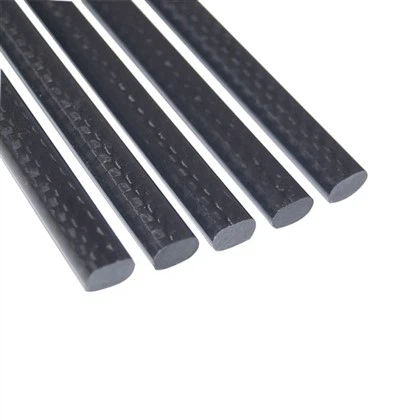
Carbon fiber rods are solid composite profiles made from carbon fibers embedded in a polymer resin matrix, usually epoxy or vinyl ester. In most industrial applications, they are manufactured by pultrusion, a continuous process in which carbon fibers are pulled through resin and then through a heated die to form a straight rod with consistent cross-section and high longitudinal fiber alignment. This structure gives pultruded carbon fiber rods excellent strength and stiffness along the length direction, making them especially suitable for applications where axial load, bending rigidity, low deflection, and lightweight design are important. Unlike isotropic metals, carbon fiber composites are anisotropic, meaning their properties vary depending on fiber direction. This is a critical point for selection: carbon fiber rods are usually strongest along the fiber direction but much weaker in transverse or shear loading.
How to Evaluate Strength, Stiffness, and Load Direction When Choosing Carbon Fiber Rods
When selecting carbon fiber rods, strength and stiffness should be evaluated separately. Strength refers to the maximum stress a material can withstand before failure, while stiffness refers to resistance to deformation under load. A rod can be very strong but still deflect more than expected if its diameter, length, fiber orientation, or modulus is not suitable. For industrial and structural applications, engineers should first identify the primary load case: tension, compression, bending, torsion, shear, vibration, or combined loading. Pultruded carbon fiber rods are typically excellent in longitudinal tension and bending because most fibers are aligned along the rod axis. They are less ideal for high transverse loads, crushing loads at clamps, threaded connections, or impact zones unless special design features are added.
Diameter is another critical factor. Bending stiffness increases significantly as diameter increases because the second moment of area rises rapidly with rod radius. Therefore, a small increase in diameter can greatly reduce deflection. For long-span supports, camera booms, drone spars, inspection equipment, and automation frames, stiffness-to-weight ratio often matters more than ultimate tensile strength. Engineers should calculate expected deflection rather than selecting rods based only on tensile strength. Compression performance must also be checked, especially for long slender rods. A carbon fiber rod may have high compressive material strength, but a long unsupported member may fail by buckling at much lower load. In such cases, end support condition, unsupported length, straightness, and diameter tolerance are just as important as material strength.
How Manufacturing Process, Fiber Type, and Resin System Affect Carbon Fiber Rod Performance
The performance of carbon fiber rods is not only dependent on the grade of carbon fibers, but also closely related to the manufacturing process. The three most important factors affecting performance are fiber type, fiber volume fraction, and resin system. Due to a good balance between strength, stiffness, availability, and cost, standard modulus carbon fibers are widely used. High modulus fibers can increase stiffness, but they may reduce the fracture strain and increase costs. For many industrial projects, standard modulus pultruded carbon fiber rods offer the most practical cost-performance ratio. The performance of the finished rods is usually lower than that of the raw material fibers because the resin matrix, fiber orientation, pores, and interface quality all affect load transfer.
Pultrusion is one of the most common processes for carbon fiber rods. It produces continuous, straight profiles with aligned fibers, stable dimensions, and efficient production cost. Because fibers are mainly oriented along the length, pultruded carbon fiber rods are ideal for tension, compression, bending, lightweight reinforcement, push rods, mechanical supports, and structural stiffeners. However, the same unidirectional structure may not perform well under high torsion or transverse impact. If the application involves twisting loads, multi-directional reinforcement, braided structures, or roll-wrapped tubes may be more suitable than solid pultruded rods. For example, a robotic arm link requiring high torsional stiffness may perform better with a carbon fiber tube using ±45° fiber layers rather than a solid rod with only axial fibers.
The resin system determines temperature resistance, chemical resistance, moisture resistance, fatigue durability, and bonding behavior. Epoxy resin is commonly used for high-performance carbon fiber rods because of its mechanical strength, adhesion, and dimensional stability. Vinyl ester may be selected for corrosion resistance and industrial environments. The glass transition temperature, often abbreviated as Tg, is especially important. Tg is the temperature range where the resin matrix begins to soften and lose stiffness. If a carbon fiber rod is used near motors, curing ovens, battery systems, outdoor sunlight, or industrial equipment with heat generation, the operating temperature should remain safely below the resin Tg. Avient lists typical Tg values of 65–160°C for CFRP barstock and pultruded profiles, showing why resin selection must match service temperature.
Quality control should not be ignored. A rod made with high-grade fiber can still fail prematurely if fiber alignment is poor, resin impregnation is incomplete, void content is high, the surface is damaged, or diameter tolerance is inconsistent. For industrial purchasing, buyers should ask for tensile strength, modulus, density, fiber volume content, resin type, Tg, diameter tolerance, straightness tolerance, surface finish, and cutting/machining capability. For structural use, batch testing and documented inspection are recommended. A professional supplier should be able to explain whether values are typical values, minimum guaranteed values, or design allowables. This distinction is important because many catalog data sheets provide typical laboratory values, not certified minimum performance for every production batch.
How to Choose Carbon Fiber Rods for Different Industrial and Structural Applications
Different applications require different selection logic. For industrial automation and robotics, the main targets are low weight, high stiffness, vibration control, repeatability, and fatigue resistance. A carbon fiber rod used in an automated handling system should be selected according to dynamic load, acceleration, end-effector weight, unsupported length, and connection design. Lower mass can reduce motor load and improve motion response, but stiffness must still be high enough to prevent vibration and positioning error. For robotic arms, gantry systems, inspection equipment, and semiconductor handling, dimensional tolerance and straightness can be as important as tensile strength. In these cases, buyers should request tight diameter tolerance, consistent surface finish, and machining compatibility.
For UAVs, aerospace tooling, and lightweight transportation components, the key selection factors are stiffness-to-weight ratio, fatigue performance, environmental stability, and repeatability. Carbon fiber rods can be used as spars, braces, push rods, reinforcement pins, and structural supports. However, designers must avoid stress concentration at joints because composite rods are sensitive to local crushing and delamination. Bonded joints, sleeves, and carefully designed inserts are usually preferred. If the component is exposed to outdoor environments, ultraviolet exposure, moisture, and temperature cycles should be considered. A protective coating or suitable resin system may be required.
For civil engineering and structural reinforcement, the selection process becomes more conservative. Carbon fiber reinforced polymer rods may be considered where corrosion resistance, low weight, and high tensile strength are valuable. The Federal Highway Administration recognizes FRP composites as materials used in both existing structures and new construction, and notes lightweight and corrosion resistance as advantages for FRP bridge decks, CFRP prestressing strands, GFRP rebars, and FRP pultruded structural members [6]. However, structural applications require compliance with design codes, inspection procedures, and engineer-approved calculations. Although that code is for GFRP rather than CFRP rods, it demonstrates the level of documentation and engineering control expected when FRP reinforcement is used in building structures.
For marine, chemical, and outdoor industrial applications, corrosion resistance is often the primary reason to select carbon fiber rods. Unlike steel, carbon fiber composites do not rust, but they are not immune to all environmental issues. Resin degradation, galvanic corrosion when connected to certain metals, UV exposure, and moisture ingress must be evaluated. In electrically sensitive equipment, carbon fiber's electrical conductivity may be either an advantage or a risk. For example, carbon fiber rods should be used carefully around antennas, sensors, electrical isolation zones, or high-voltage environments. In such cases, fiberglass rods or hybrid FRP rods may be more suitable.
What Technical Data Should Buyers Request Before Purchasing Carbon Fiber Rods?
Professional buyers should not choose carbon fiber rods based only on appearance, price, or diameter. A black glossy rod is not automatically suitable for structural use. Before purchasing, buyers should request a technical data sheet and clarify whether the stated properties are typical values, minimum values, or design allowables. At minimum, the supplier should provide tensile strength, tensile modulus, flexural strength, flexural modulus, density, fiber volume fraction, resin system, glass transition temperature, diameter tolerance, straightness tolerance, surface finish, and recommended cutting or bonding method.
A practical selection workflow begins with the application environment. First, define whether the rod will work mainly in tension, compression, bending, torsion, or combined loading. Second, determine maximum working load, acceptable deflection, service temperature, exposure to moisture or chemicals, and expected life cycle. Third, select the manufacturing process and material grade. For axial or bending-dominated applications, pultruded carbon fiber rods are often efficient. For torsional or impact-prone designs, a tube or custom layup may be more appropriate. Fourth, check diameter and length using engineering calculations, not visual estimation. Fifth, design the connection system to spread load and avoid fiber damage. Sixth, verify supplier data through samples, inspection, or third-party testing when the application is safety-critical.
Cost should be evaluated through total performance, not only unit price. A low-cost rod with unknown resin, poor fiber alignment, wide tolerance, or no test data may be expensive if it causes equipment vibration, early failure, installation problems, or product returns. Conversely, an aerospace-grade rod may be unnecessary for a simple non-critical fixture. The best choice is the rod that meets engineering requirements with an appropriate safety margin and stable supply quality. For repeated industrial production, buyers should also confirm batch consistency, lead time, cutting service, custom diameter availability, surface treatment options, and packaging protection during shipment.
In summary, carbon fiber rods are valuable engineering materials when their anisotropic behavior, load direction, resin temperature limit, connection method, and testing basis are properly understood. For industrial and structural use, the right carbon fiber rod should be selected by performance data, not by appearance. Buyers should work with suppliers that can provide clear specifications, explain manufacturing processes, support customization, and supply consistent quality documentation.
Conclusion
Choosing carbon fiber rods for industrial and structural use requires a balance of strength, stiffness, weight, durability, temperature resistance, dimensional tolerance, and cost. The most important principle is to match the rod's properties to the actual load path and service environment. Pultruded carbon fiber rods are highly effective for axial and bending-dominated applications, but they require careful design when exposed to torsion, transverse load, drilling, clamping, or impact. For structural applications, buyers should request test reports, standards-based data, and professional design verification. When selected correctly, carbon fiber rods can reduce weight, improve rigidity, extend service life, and support advanced engineering designs across robotics, UAVs, civil infrastructure, precision machinery, marine equipment, and industrial automation.
Contact Us
We are a professional manufacturer of carbon fiber rods from China. If you want to know the details of the application of our high-quality carbon fiber rods, please feel free to contact us via sales18@julitech.cn or WhatsApp (+86 18822947075). Our expert team is always ready to help you find the solution that best suits your project. We have a factory with an area of 10,300 square meters and 20 production lines. Welcome to visit our factory in China!