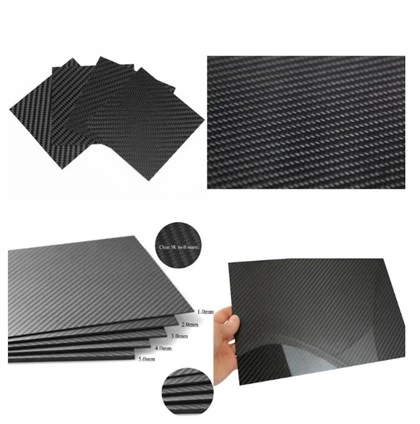
In today's rapidly evolving market environment, innovation in materials technology is increasingly becoming a key factor determining product competitiveness and market lifecycle. As global manufacturing continues to upgrade towards lightweighting, high strength, and sustainability, carbon fiber sheets are no longer limited to high-end fields such as aerospace or Formula One racing, but are being rapidly applied in various industries including high-end consumer electronics, medical devices, intelligent equipment, and industrial automation. How to fully leverage the advantages of carbon fiber sheets in terms of mechanical properties, structural stability, and corrosion resistance to optimize product design, improve performance, and further build differentiated competitive advantages has become a crucial issue of focus for contemporary engineers and product designers.
How do the mechanical properties of carbon fiber sheets reshape the structural efficiency of products?
The core advantage of carbon fiber sheets lies in their excellent specific strength and specific modulus. In modern product design, structural efficiency usually means minimizing overall weight while meeting strength and stiffness requirements. Although traditional metal materials such as steel and aluminum alloys have mature processing technologies and stable performance systems, their potential for improvement in lightweighting is relatively limited.
Taking common T300 and T700 grade carbon fiber sheets as examples, their tensile strength typically reaches 3500–4900 MPa, while their material density is only about 1.5–2.0 g/cm³. In contrast, the tensile strength of ordinary structural steel is generally 400–600 MPa, but its density is as high as 7.8 g/cm³. That is to say, under the same load conditions, structural components made of carbon fiber sheets can be more than 70% lighter than traditional steel structures, while still maintaining excellent structural strength and rigidity.
In the application of high-strength carbon fiber sheets, the structural advantages brought by their high specific strength and high specific stiffness can often be directly translated into product competitiveness. Taking the drone industry as an example, using carbon fiber sheets for the fuselage frame can not only effectively reduce the overall weight and improve the flight range, but also maintain good bending resistance and structural stability under high-speed flight and complex working conditions. For high-performance equipment, this performance improvement brought about by the material itself is usually difficult to replace by algorithm optimization or electronic hardware upgrades alone.
How can we utilize the anisotropy of carbon fiber sheets for customized design?
Unlike the isotropic properties of traditional metallic materials, carbon fiber sheets are typical anisotropic materials, and their mechanical properties vary significantly with changes in fiber alignment. While this characteristic places higher demands on structural design and engineering calculations, it also provides greater flexibility for customized carbon fiber sheet layup designs.
By adjusting the layup angle of the prepreg, such as 0°, 90°, or ±45°, engineers can precisely control the strength, stiffness, and torsional properties of carbon fiber sheets in different directions to meet specific stress requirements. For example, for structural components that mainly bear uniaxial tensile loads, more fibers can be concentrated in the 0° direction to achieve higher tensile strength with extremely low weight; while for structural components that need to withstand shear force, bending stress, or complex loads simultaneously, a quasi-isotropic layup scheme is usually adopted to achieve more balanced comprehensive mechanical properties.
This design approach of "defining material properties according to needs" gives carbon fiber sheets unparalleled flexibility in product structure optimization compared to traditional materials. Taking high-end sports equipment as an example, in the development of carbon fiber bicycle frames, skis, or competitive equipment, engineers can optimize local ply structures to achieve a combination of high-rigidity support in some areas and flexible shock absorption in others, thereby achieving a more ideal balance between handling, stability, and comfort.
What advantages does the chemical stability of carbon fiber sheets offer in harsh environments?
For products used extensively in marine engineering, chemical equipment, or medical sterilization environments, corrosion is often a key factor affecting equipment lifespan and stability. Compared to traditional metal materials, carbon fiber sheets have a significant advantage in chemical stability. Due to the high chemical inertness of carbon itself, carbon fiber sheets can generally withstand the erosion of most acids, alkalis, and organic solvents, thus maintaining stable structural performance even in complex environments.
When developing corrosion-resistant carbon fiber sheets, engineers typically do not need to consider additional issues such as anti-rust coatings, surface electroplating, or periodic maintenance as they would with steel. Carbon fiber sheets are resistant to rust and do not easily suffer performance degradation due to moisture or chemical media, making them widely applicable in fields such as marine exploration equipment, chemical instruments, medical equipment, and high-end laboratory facilities.
From a market perspective, the "long lifespan and low maintenance" characteristics of carbon fiber sheets can also bring higher commercial value to products. When end customers find that their equipment can maintain stable performance for a long time, even in high humidity, high corrosion, or high frequency disinfection environments, and reduce subsequent maintenance costs, the added value brought by the material itself will further translate into brand trust and market competitive advantage.
How can we achieve large-scale application through process optimization of carbon fiber sheets?
With the continuous advancement of composite material manufacturing technology, carbon fiber sheets are gradually moving from high-end applications to large-scale industrial use. To achieve this goal, process optimization is crucial. On the one hand, the application of automated layup, hot pressing, molding processes, and continuous production technologies can effectively improve production efficiency, reduce human error, and shorten manufacturing cycles. On the other hand, optimizing the resin system, fiber layup structure, and curing parameters can not only improve the mechanical properties and stability of carbon fiber sheets but also reduce material waste and energy consumption, thereby lowering overall production costs. Furthermore, introducing the Design for Manufacturing (DFM) concept during the product design phase can further simplify processing procedures, improve material utilization, and enhance batch production consistency. With the widespread adoption of intelligent manufacturing and automated equipment, carbon fiber sheets will achieve broader large-scale applications in fields such as drones, automotive lightweighting, industrial robots, medical devices, and new energy.
Common Industry Problems and Solutions
Q: Does the brittleness of carbon fiber sheets increase the risk of product failure under high-impact environments?
Although carbon fiber sheets are brittle materials, unlike metals which exhibit significant plastic deformation (yield) before fracture, modern engineering has developed various strategies to address this challenge. First, during the product design phase, a hybrid material strategy can be used to combine carbon fiber with Kevlar or glass fiber, leveraging Kevlar's extremely high toughness to enhance the overall structure's impact resistance and energy absorption rate. Second, using toughened epoxy resin as a matrix can delay crack propagation at the microscopic level.
In addition, to address potential brittle fracture, designers can introduce "structural redundancy." Through multi-level anisotropic arrangement, it is ensured that even if local fibers break, the load can be transferred to adjacent fiber layers through the resin, preventing catastrophic overall collapse. In practical applications, such as mountain bike frames or racing car crash structures, engineers utilize specific fiber weaving structures (such as 3D weaving) to guide energy dissipation. Therefore, with proper design, carbon fiber sheets are fully capable of handling high-impact load applications while enjoying the benefits of lightweight construction.
Contact us
For more information about how our high-quality carbon fiber sheets can enhance your projects, please feel free to contact us at sales18@julitech.cn. Let us help your projects reach new heights with advanced carbon fiber solutions.